
My mind went utterly blank when Elara asked the Thornwall Tavern barkeep’s name. My notes, a sprawling document I called "The Tome of Infinite Possibilities," contained zero information on the man sweating behind the bar. He was supposed to be a footnote, a generic provider of ale. Elara, my rogue, had a knack for latching onto the inconsequential. My carefully constructed plot hook, a whispered rumor about a stolen artifact, hung in the air, forgotten. The silence stretched.
This isn't about a lack of effort. It's about a specific kind of DM insecurity. We spend hours crafting intricate lore, sketching out cities, and detailing monster stat blocks. We do it because we fear the blank space. We fear the player question we can't answer, the unexpected tangent that unravels our web. We convince ourselves more prep equals a better game. It rarely does. We over-prep not out of genuine creative need, but because we're afraid of looking unprepared, even if it means our players miss the magic we're trying to create.
The problem isn't the amount of prep, but the type. You're building a house, but you're carving doorknobs before you've laid the foundation. Building only what players interact with is the solution. This technique is The Iceberg Three. It's simple, brutal, and effective.
For any character, location, or plot element your players are likely to encounter, you need three pieces of information. Three. Not thirty.
- The Hook: What is the immediate, obvious thing the players see or hear? (e.g., A gruff barkeep, a dimly lit room, a cryptic note.)
- The Want: What does this element desperately desire? (e.g., The barkeep wants respect, the room wants to be left alone, the note wants to be delivered.)
- The Secret: What is the one thing this element is hiding, or that is hidden about it? (e.g., The barkeep isn't who he says he is, the room is a secret portal, the note is a coded threat.)
That's it. Three points. You can flesh out the rest on the fly. Let player actions dictate what becomes important.
Let's see The Iceberg Three in action. The party investigates a missing merchant in the port city of Saltwind. They've heard whispers Captain Valerius, a notoriously stern harbor master, might know something.
Saltwind Harbor Master – Captain Valerius
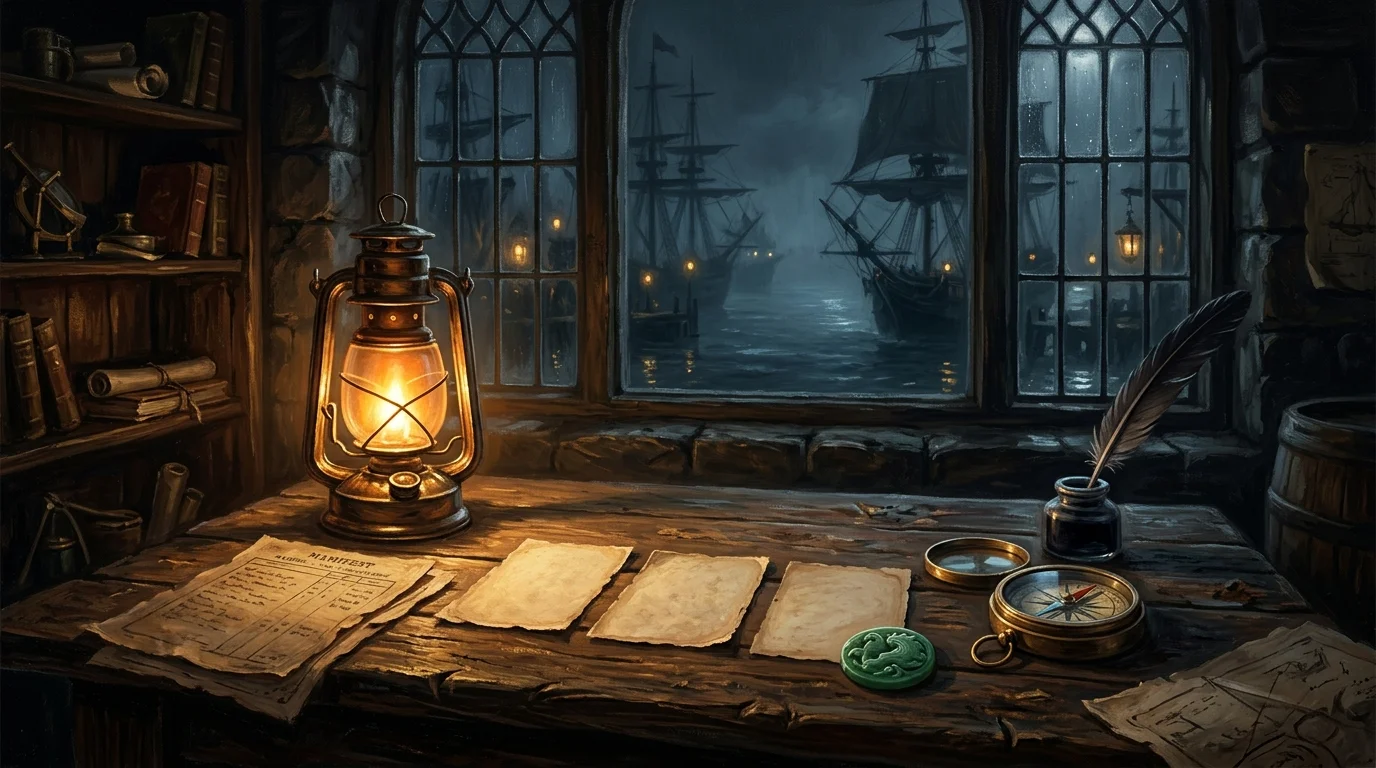
- The Hook: A towering, granite-faced man whose crisp naval uniform is immaculate despite the perpetual smell of stale fish and cheap rum clinging to his office. He glares over his spectacles, his pen tapping an impatient rhythm on a desk cluttered with ship manifests and a half-eaten apple.
- The Want: To maintain absolute order and efficiency in the bustling Saltwind docks. He despises any disruption to his carefully regulated schedule, seeing it as a personal affront.
- The Secret: He's secretly a crippling gambler, deeply in debt to the Crimson Tide Syndicate—the same shadowy guild that might be involved in the merchant's disappearance. He needs this merchant found, but not for the reasons he'll tell the party; he needs the merchant’s hidden ledger, which he believes contains proof of the guild’s illicit activities.
This gives you everything you need. If players barge in demanding answers, Valerius is gruff (Hook). If they try to bribe him or appeal to his sense of duty, he'll talk about maintaining order (Want). If they push, or a clever player notices he’s fidgeting with a jade gambling token, the Secret is on the table.
This is where the "best D&D DM tools 2026" conversation gets interesting. The real tool isn't software for software's sake. It's about leveraging systems to accelerate your own creative scaffolding. When I use the Inskryb NPC generator, it doesn't just spit out a paragraph of backstory. With a single prompt and a few clicks, it generates the three core elements for an NPC—the Hook, the Want, and the Secret—already formatted. Instead of staring at a blank page for an hour, I have a usable, three-point character skeleton in under 60 seconds. I then spend just a few minutes adding specific details to tie it into my campaign, turning a generic concept into a compelling interaction point.
Before your next session, grab three index cards. Write a name on each for an NPC the party might talk to. Under each name, jot down: what they want, what they're hiding, and one weird thing about them. That's it.