
Beyond the Binder: Your Essential D&D Campaign Notes Template
Ever spend three hours meticulously detailing a noble's ballroom, only for your players to ignore it entirely and decide to interrogate the stable boy? Or perhaps you've hit that dreaded mid-session freeze, a player asks an unnamed guard for his life story, and you're left scrambling to invent a compelling backstory on the spot? These are the classic DM headaches, and they often boil down to one thing: your campaign notes aren't working for you.
The truth is, traditional, sprawling campaign notes, while well-intentioned, can become an unwieldy beast. We pour hours into them, building intricate lore and detailed locations, only to find ourselves lost in a sea of binders or a disorganized digital folder when the unexpected happens. This constant scramble for information, or the realization that hours of prep went unused, erodes the joy of DMing, turning collaborative storytelling at the table into solitary, often frustrating, work behind the screen.
What if your campaign notes could be less of a burden and more of a launchpad? What if they offered structure without stifling improvisation, and organization without demanding hours of manual upkeep? Let’s ditch the overwhelming binders and explore some simple, practical methods for managing your campaign, methods you can implement with pen and paper tonight, before we even think about digital tools.
The Power of Three: Anchors for Your NPCs
One of the biggest drains on DM energy is the sheer volume of named NPCs. If your players latch onto someone they weren’t expecting, you need something to make them feel real. Forget full biographies for every town guard. Instead, embrace the "Three-Bullet NPC Anchor."
For every significant (or potentially significant) NPC, jot down just three key things:
- A Core Motivation/Desire: What do they want more than anything? (e.g., "Wants to protect their family," "Seeks revenge for a past wrong," "Desires wealth and status.")
- A Defining Flaw/Quirk: What makes them imperfect or memorable? (e.g., "Overly superstitious," "Has a terrible stutter under pressure," "Secretly terrified of spiders.")
- A Hook/Connection: How can they tie into the plot or player actions? (e.g., "Knows a secret about the local lord," "Owes a favor to a shadowy organization," "Witnessed something the players need to know.")
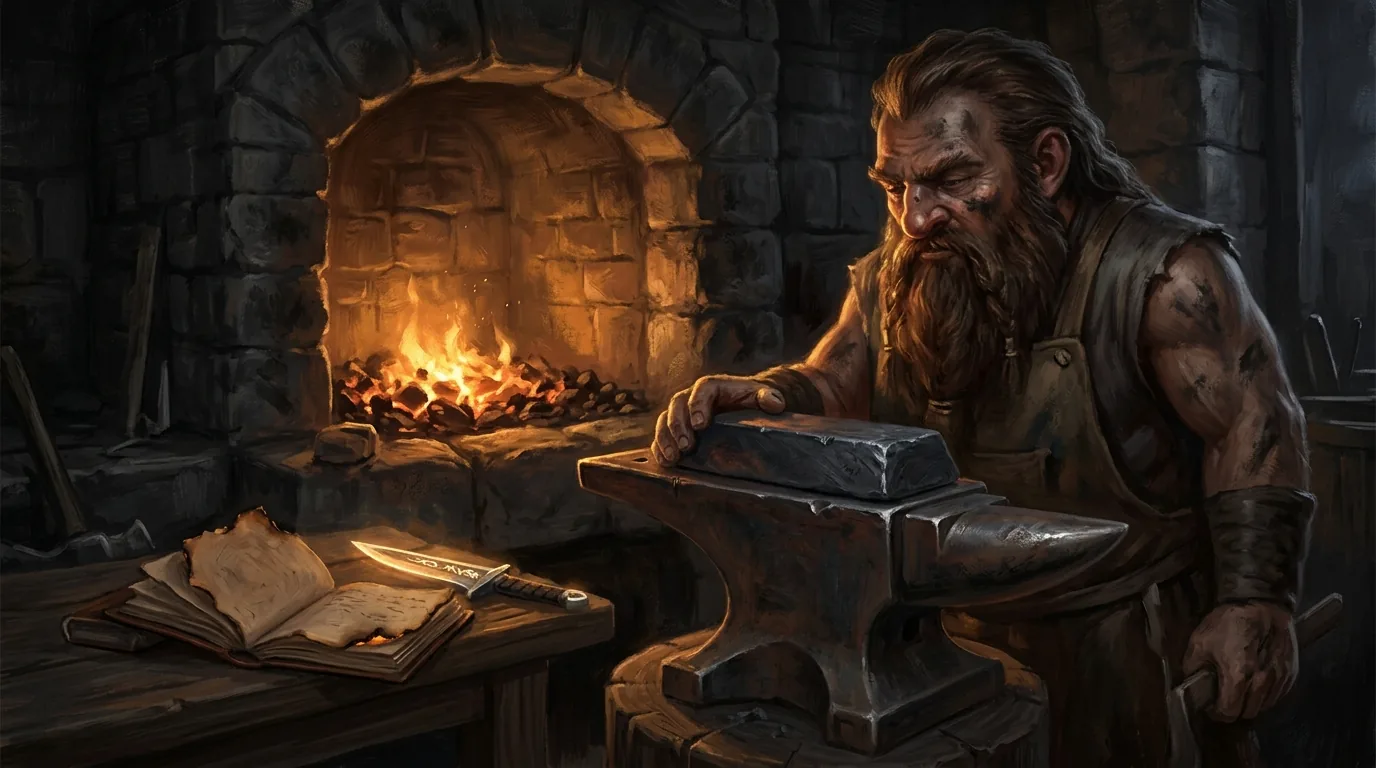
This minimal framework provides instant personality and plot relevance. When a player asks the blacksmith about his past, you’ve got the seeds: his motivation is providing for his aging mother, his flaw is a stubborn refusal to ask for help, and his hook is that he’s been secretly supplying weapons to the rebels for years. Instant depth.
Example NPC Anchor:
Name: Torvin Stonehand, Town Blacksmith
- Motivation: To see his daughter marry well and escape the hardship of this town.
- Flaw: Prone to grumbling and overly critical of "fancy city folk."
- Hook: He has a hidden stash of dwarven-made adamantine ingots, purchased long ago, that could be vital for crafting a legendary weapon. He’s also nursing a significant gambling debt.
Schrödinger's Encounters: Prepare, Don't Over-Prepare
We’ve all been there: spending hours on a detailed ambush encounter, only for the players to take a detour, bypass the area entirely, or even decide to parley with the goblins. This is where the "Schrödinger's Encounter" concept comes in. The encounter is both prepared and unprepared until it’s observed by the players.
Instead of detailing every arrow and flanking maneuver, focus on the core elements:
- The Conflict/Challenge: What is the fundamental problem or opposition? (e.g., "Bandits blocking the road," "A magical trap in an ancient ruin," "A social encounter with a suspicious guild master.")
- The Key Players/Forces: Who or what is involved on the opposition's side? (Stat blocks, not necessarily names, unless they are significant.)
- The Objective/Desired Outcome: What does success look like for the players? What do the adversaries want?
When the players actually encounter this situation, you then layer in the details. For a bandit ambush, you might decide mid-fight that the leader is particularly cowardly, or that one of the bandits has a distinctive scar. This "just-in-time" preparation saves immense prep time and keeps your encounters fluid.
The 3x3 Rumor Grid: Injecting Life into Taverns and Towns
The classic tavern scene can feel stale if the rumors are generic. A 3x3 grid is a simple way to generate diverse and useful rumors that can seed future plot hooks. Draw a 3x3 grid on a piece of paper or a digital note.
- Row 1: Current Local Issues: What's happening right now in the immediate vicinity? (e.g., "The harvest is failing," "A new tax has been imposed.")
- Row 2: Whispers from Afar: What are people hearing about the wider world or distant lands? (e.g., "Talk of war in the north," "Strange lights seen over the Shadow Peaks.")
- Row 3: Oddities and Mysteries: What are the strange, unexplained, or fantastical occurrences? (e.g., "Livestock disappearing without a trace," "Folk complaining of unsettling dreams.")
Now, assign a category to each column:
- Column A: Objective Facts/Observations: What people have seen or experienced directly.
- Column B: Personal Anecdotes/Gossip: What someone’s cousin heard from a friend.
- Column C: Superstitions/Fears: What people are imagining or attributing to magic/the supernatural.
Fill in the grid. The intersection of "Current Local Issues" (Row 1) and "Objective Facts/Observations" (Column A) might be "The Duke's tax collector was found tied to the town well this morning." The intersection of "Whispers from Afar" (Row 2) and "Superstitions/Fears" (Column C) could be "They say the king's nightmares are bleeding into reality, causing the recent unrest." This creates a rich tapestry of information that players can pick and choose from, and even misinformation that can lead them astray.
Example Rumor Grid Snippet:
| Objective Facts | Personal Anecdotes | Superstitions/Fears | |
|---|---|---|---|
| Local Issues | Market stall vandalized overnight. | My neighbor swears they saw a goblin! | The woods are cursed; stay clear after dark. |
| Distant Whispers | Trade caravans are late from the coast. | Heard the Baron is raising his army again. | The stars are aligning for a dark prophecy. |
| Oddities/Mysteries | Strange glowing mushrooms appearing. | My dog keeps barking at nothing in the attic. | Something ancient is stirring beneath the old ruins. |
Scenario Example: Torvin and the Whispered Debt
Imagine your players are in Torvin Stonehand's smithy, drawn by a rumor they overheard (perhaps from the "My neighbor swears they saw a goblin!" slot on the rumor grid, leading to general suspicion). They notice Torvin’s strained expression.
"Is something bothering you, blacksmith?" one might ask.
This is where the "Three-Bullet NPC Anchor" comes into play. You recall:
- Motivation: Daughter's well-being.
- Flaw: Grumbling, critical.
- Hook: Gambling debt, hidden adamantine.
"Bah! Just the usual troubles, fancy folk," Torvin grumbles, his hammer hitting the anvil with a bit too much force. (His flaw in action). "This town… no good for honest folk, especially my Elara. Needs a better life than this." (His motivation subtly revealed).
If the players press further, or if they happen to mention something about the strange glowing mushrooms appearing in the woods (from the rumor grid's "Oddities/Mysteries" and "Objective Facts" intersection), you could have Torvin nervously glance towards a specific, reinforced chest in the corner. "Those things… they say they glow with a strange power. Best leave 'em be." He might then, with a sigh, mention how a 'friend' from out of town once offered a substantial sum for 'certain rare metals,' a veiled reference to the adamantine, and how he's been struggling to repay a loan for his daughter's dowry, hinting at the hook.
When Life Gives You Lemonades... Make Digital Lemonade with Inskryb
These analog methods are powerful, but they still involve manual creation and organization. This is where a tool like Inskryb (inskryb.com) can become a valuable digital assistant, augmenting your creativity by automating the tedious scaffolding.
Imagine taking those three NPC anchor points and feeding them into Inskryb. Instead of spending 15 minutes digging through stat block websites, Inskryb can generate a fully statted NPC, complete with appropriate challenges for your party level, in seconds. That’s the core of Inskryb: it takes the foundational work off your plate, freeing you up for the narrative work at the table.
When you use Inskryb’s tools, it’s not about pushing a button and getting a perfect story. It’s about using those AI-powered generation capabilities to flesh out the structures you’ve already defined with your analog tricks. Got a "Schrödinger's Encounter" idea? Inskryb can generate a variety of monster stat blocks, environmental hazards, or even social encounter prompts based on your keywords, so when the encounter is observed, you have a wealth of ready-to-deploy options.
Similarly, that 3x3 rumor grid can be amplified. Inskryb can take your broad themes and generate evocative snippets of rumor, dialogue, or lore that you can then curate and weave into your game. It can even help you build out the details of locations or generate random loot tables on the fly, all designed to support the framework you’ve built. The goal is always to have more time for improvisation, reactive storytelling, and genuine connection with your players.
Take Control of Your Campaign Notes
Your campaign notes should be a tool, not a burden. By adopting simple, structured approaches like the Three-Bullet NPC Anchor, Schrödinger's Encounters, and the 3x3 Rumor Grid, you can build a robust framework that supports your game without demanding endless hours of preparation.
These techniques are your starting point for a more manageable and enjoyable DMing experience. They are the bedrock upon which you can build truly unforgettable adventures. If you find yourself wishing you had more time to focus on the magic of storytelling and less time wrestling with your notes, explore how tools like Inskryb can help automate the grunt work, leaving you free to lead your players on an epic journey.
Ready to transform your prep? Visit Inskryb.com and see how a smart campaign assistant can empower your storytelling.