
The goblin ambush had been a disaster. Not for the players—they steamrolled the poor sods in three rounds. It was a disaster for me. My carefully crafted "deadly" encounter evaporated. It left a gaping hole where tension was supposed to be. The fighter, bless his overenthusiastic dice, crit on his opening attack.
We all know the feeling. You plug monsters into a dnd encounter difficulty calculator. You stare at the "deadly" rating. Then you convince yourself it's fine. You’ve done the math. This should be a fight. Then the dice betray you, or players deploy forgotten cantrips. Your entire plan crumbles. This isn't about calculator accuracy; it's about our flawed understanding of what makes an encounter work.
We build these encounters like LEGO sets, piece by perfectly balanced piece, because we’re terrified of looking incompetent. We over-prepare to prove we’re good DMs. It’s insecurity masquerading as diligence. We think if we can just calculate the challenge perfectly, the fun will magically follow. We desperately want players to think we have it all figured out, even when we’re just guessing. The truth is, fun doesn't come from numbers. It comes from stakes. It comes from characters reacting. The calculator tells you how many hits it might take. It doesn't tell you if anyone will care.
This is where the Threat Palette comes in. Forget precise XP. Think of your encounter like a painter’s palette. You have your base colors (the main monsters), your highlights (special abilities or terrain), and your accents (environmental hazards or unexpected reinforcements). For a goblin ambush, your base might be four goblins. The highlight? Their leader has a rusty net. The accent? A narrow, muddy ravine. It offers cover to half of them. You just need a few distinct elements that interact.
Here’s how to deploy it:
- Identify the Core Threat: What’s the main thing the players are fighting? (e.g., a pack of wolves, a disgruntled merchant, a magical trap).
- Add One Complication: What makes this not just hitting a bag of hit points? This could be terrain, a unique monster ability, or an external factor (like civilians nearby).
- Introduce One "Wildcard": What’s something unexpected that could happen? This isn't a guaranteed event, but a possibility that adds a layer of uncertainty.
Let's try this. The party, the Blades of Orellia, are escorting a merchant caravan through the Whispering Pines. My notes say "four bandits, CR 1/8." The calculator spat out "easy." Boring. Time for the Threat Palette.
- Core Threat: Six bandit thugs. Standard stuff. Their primary goal is the alchemist's crate.
- Complication: The bandits aren’t just after coin; they’re trying to steal a specific crate. It contains illegal alchemical components. One thug, Bixby, is an alchemist’s apprentice. He knows how to trigger a small, volatile reaction if the crate is damaged.
- Wildcard: A pack of hungry dire wolves is drawn by the commotion and the smell of blood. They’ll attack whoever is closest, bandit or PC.
This is a much richer situation. The party can’t just charge in. Do they protect the crate? Do they try to intercept Bixby? Do they fight the wolves first? The calculator never told me any of that.
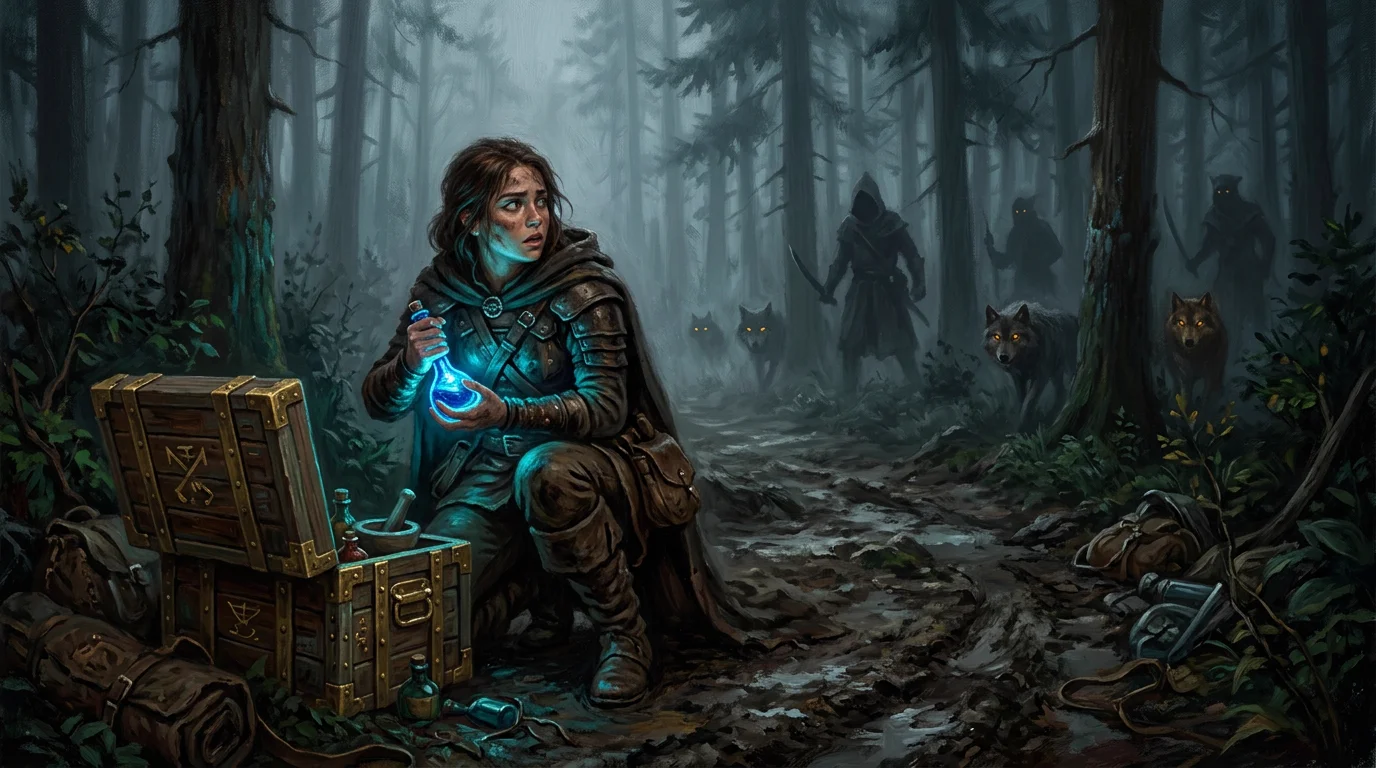
Now, picture this: the Blades of Orellia are deep in the Whispering Pines. The scent of damp pine needles and distant woodsmoke hangs heavy. Suddenly, rough voices erupt from the trees. Six bandit thugs emerge, led by a scrawny fellow in greasy leather. Their eyes fix on the brightly painted crate of the alchemist’s apprentice, Bixby. He barks orders, a crude vial of shimmering blue liquid clutched in his hand. Chaos brews. As steel flashes, a low, guttural growl echoes from the treeline—a dire wolf pack, drawn by the scent of violence.
Here’s how to quickly sketch this scenario for yourself:
Encounter Artifact: The Whispering Pines Ambush
(Imagine this as a downloadable PDF, a Trello card, or a physical index card.)
Location: Whispering Pines Road Sensory Detail: Damp earth and distant woodsmoke hangs heavy in the air.
Core Threat:
- Six Bandit Thugs:
- Goal: Steal the alchemist's crate.
- Stats: Standard CR 1/8.
Complication:
- Bixby, the Alchemist's Apprentice
- Flaw: Reckless, easily panicked.
- Want: Prove alchemical skill.
- Special: Volatile Crate. Crate damage triggers an action by Bixby to ignite contents.
- Effect: 10ft radius explosion (2d6 fire, Dex save DC 12 for half).
Wildcard:
- Dire Wolf Pack (1d4+1):
- Trigger: Drawn by combat sounds/scent.
- Action: Attack nearest group (PC or bandit).
- Impact: Shifts priorities, creates multi-front battle.
The dnd encounter difficulty calculator might say six CR 1/8 bandits plus some wolves is "medium." It will never tell you that a panicked apprentice might blow himself up, or that the wolves might eat the wrong person. That’s where your creativity comes in. When I input "bandits" and "wolves" into Inskryb, the generator presents a prompt for 'Complication' and 'Wildcard' alongside the monster list. I select 'Alchemical Mishap' from the suggested complications, and Inskryb populates a field for a volatile crate with a risk of explosion. For the wildcard, I choose 'Natural Predator' and it suggests 'Dire Wolves,' providing a quick stat block and a prompt for their behavior. Bixby and his volatile crate can then be quickly slotted in, saving the blank stare of trying to invent a complication on the fly.
Before your next session, grab three index cards. Write the names of the three most likely NPCs the party will interact with. Under each name, jot down: what they want, what they're hiding, and one quirky habit. That's your entire NPC prep.