
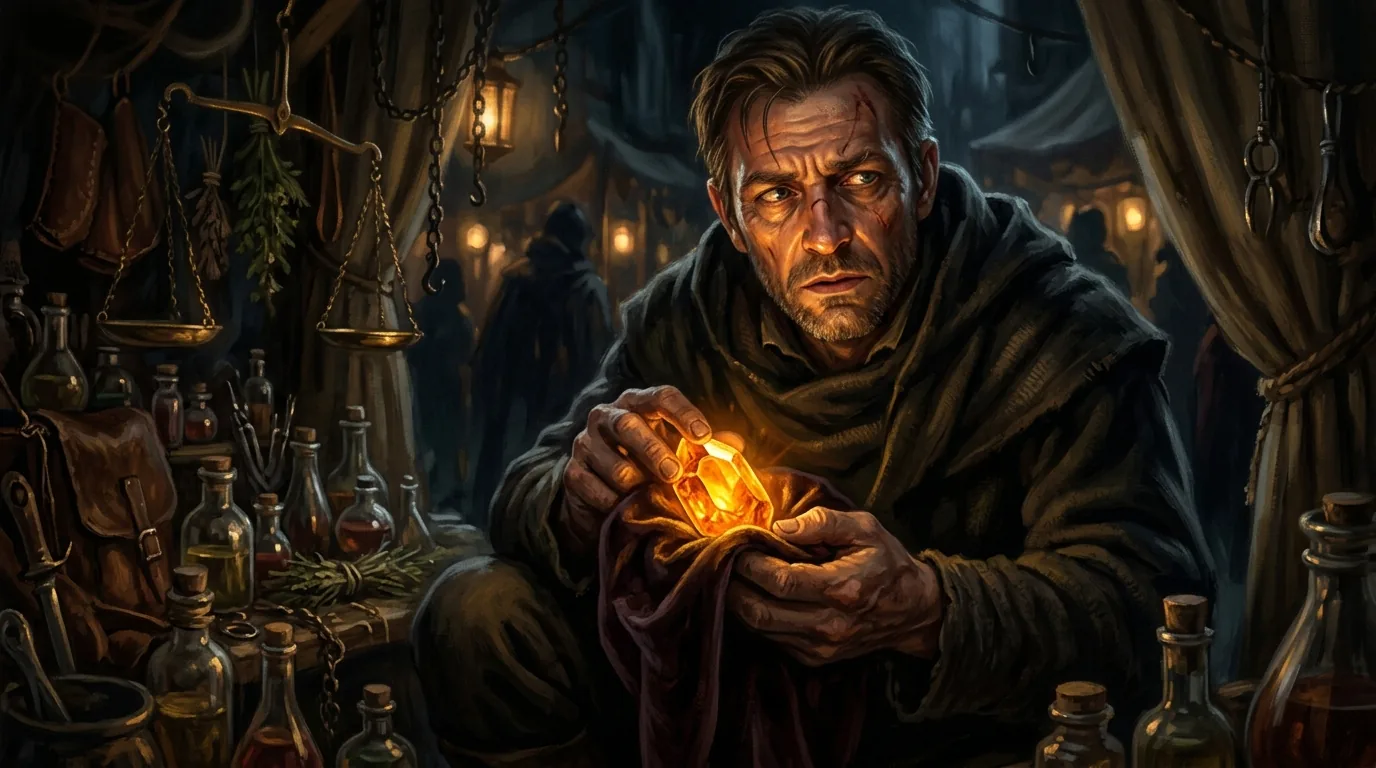
You've poured hours into a D&D session – detailed maps, intricate traps, compelling NPCs. You're ready. Then, your players spend two hours interrogating the single goblin guard you barely sketched, asking about his mother's favorite goblin recipe. Or they completely bypass your carefully crafted encounter because a squirrel caught their eye. Sound familiar? This is the DM burnout paradox: the more effort you put into prep, the more likely it is that players will go in a completely different direction, leaving you feeling drained and like your work was wasted.
This friction often stems from our prep habits. We tend to prepare for what we expect to happen, creating detailed narratives and encounters that player agency can easily derail. We can get bogged down in minutiae, like stat blocks for every minor NPC, or elaborate backstories for a tavern keeper who might only serve as a plot hook for five minutes. The time spent on these details could be better spent anticipating player choices and having flexible frameworks ready.
The "Schrödinger's Encounter" & 3-Bullet NPC Anchors: Simple Prep Tricks
Let’s focus on actionable, adaptable techniques. Forget writing a novel for every session.
First, consider the Schrödinger's Encounter. Instead of scripting a specific encounter, prepare a set of modular components that you can assemble on the fly. Think of it like having a box of LEGOs ready to build whatever fits the moment. For a potential encounter, have these analog 'components' ready on an index card or in your notes:
- Location Type: (e.g., 'Forest Clearing,' 'Cave Mouth,' 'Tavern Corner,' 'Market Stall'). Jot down 2-3 sensory details.
- Mood/Atmosphere: (e.g., 'Tense,' 'Peaceful,' 'Mysterious,' 'Ominous').
- Core Interaction/Conflict Element: (e.g., 'Guards,' 'Merchants,' 'Travelers,' 'Wild Animals,' 'Puzzle Opportunity').
- Potential Goal/Reward: (e.g., 'Information,' 'Small Treasure,' 'Safe Passage,' 'Quest Hook').
When players enter a situation where an encounter might occur, pull out your index card and rapidly assemble the most fitting elements. For example, if they stumble into a forest clearing (Location Type), you might decide the mood is 'Tense' (Mood/Atmosphere), and populate it with 'Bandits' (Core Interaction/Conflict Element) who are trying to ambush travelers for 'Coin' (Potential Goal/Reward).
Second, for NPCs, implement 3-Bullet NPC Anchors. This isn't about writing a biography. It's about giving yourself three key pieces of information to bring an NPC to life instantly and make them useful for plot hooks:
- A Core Desire/Motivation: What do they want? (e.g., 'To protect their family,' 'To gain recognition,' 'To escape their past').
- A Defining Trait/Quirk: What makes them memorable? (e.g., 'Speaks with a lisp,' 'Constantly polishing their spectacles,' 'Has a pet raven').
- A Secret/Connection: What makes them relevant to the plot? (e.g., 'Owes a debt to the local crime lord,' 'Witnessed the inciting incident,' 'Has a hidden talent for alchemy').
Example: The "Shady Merchant" Anchor
Let’s flesh out a simple NPC using this method for a bustling port city:
Example: Silas "The Scurry" Vance (3-Bullet Anchor)
- Core Desire: To amass enough gold (at least 500 gp) to buy passage on the next ship to the free city of Port Azure.
- Defining Trait/Quirk: Constantly tugs at his earlobe when lying or stressed, and speaks in hurried whispers. Has a small, almost unnoticeable scar above his left eyebrow from a youthful indiscretion.
- Secret/Connection: He's currently holding the 'Sunstone of Eldoria,' a fist-sized gem recently reported stolen from the Grand Merchant Guild. He plans to sell it to a notorious fence named "Silken Sam" at the Rusty Flagon tonight.
In-Game Snippet Example: If the players approach Silas in his cramped stall: "A nervous man with darting eyes and a hand hovering near his coin pouch looks up. He tugs at his left earlobe. 'Looking for... anything specific? I have some... quality trinkets. Very unique. For the discerning buyer. Or perhaps... information?' He leans in, his voice dropping to a hurried whisper, 'I hear things, you know. Things people shouldn't hear. For the right price, of course.'"
Potential Stats/Mechanics Hook: If the players question him aggressively:
- DC 12 Persuasion/Intimidation: Silas might reveal he's trying to get rid of something valuable quickly.
- DC 15 Insight: The players notice his eyes flicker towards the back of his stall whenever the 'Grand Merchant Guild' is mentioned.
- If cornered: Silas might try to flee (use Bandit stat block, CR 1/8, with Dexterity (Acrobatics) +4 for escape). He can be bribed with 50 gp to confess where he got the Sunstone, but not its location.
How Inskryb Automates the Heavy Lifting
This kind of flexible, component-based prep is an area where tools like Inskryb can offer significant assistance. Imagine you have a session recap from your last game. You can feed that into Inskryb’s Session Summariser.
For example, if your players just dealt with a goblin raiding party in a forest clearing, you could input that. Inskryb can then:
- Generate Potential Future Encounters: Based on the goblin raid, it might suggest a follow-up: "The goblins were being led by a hobgoblin scout. Perhaps the players angered a larger hobgoblin warband in the region?"
- Create NPC Anchors: If the players interacted with a hermit who aided them, Inskryb could generate a 3-bullet anchor for that hermit, complete with potential motivations and secrets based on the context.
- Draft Stat Blocks: For the suggested hobgoblin scout, Inskryb can pull up a relevant stat block and even suggest modifications based on their previous encounter.
Instead of spending an hour sketching out stat blocks and basic NPC personalities, Inskryb can provide a solid foundation in seconds. This frees you up to focus on the why and how – the nuances of player interaction, the emotional weight of decisions, and those spontaneous moments that make TTRPGs magical. It automates the scaffolding, leaving you 90% of your energy for the storytelling.
Actionable Takeaways
The goal isn't to eliminate prep, but to make it smarter and more efficient. Start by implementing the 3-Bullet NPC Anchor for every significant NPC you introduce. For encounters, don't pre-script every detail; have modular components ready that you can assemble as needed.
Try Inskryb’s Session Summariser after your next session. Feed in your notes, and see what it generates. You might be surprised at how much time you save and how much more focused your prep becomes, leading to less stress and more fun at your table.